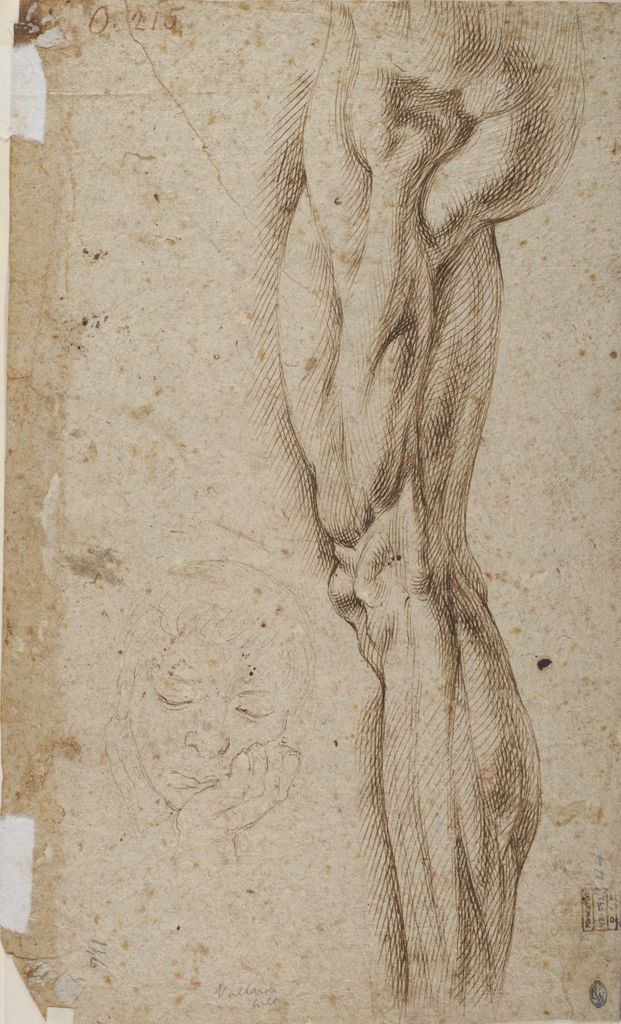
When this drawing was accessioned through the bequest of Dan Fellows Platt, it held an attribution to Baccio Bandinelli. In 1968, Felton Gibbons suggested the drawing be attributed to the Neapolitan artist Giovanni Battista Caracciolo (Il Battistello), citing stylistic similarities with sheets by the artist included in the Uffizi exhibition Cento disegni napolitani in 1967. While the drawing of the écorché leg on the verso is not copied from any early anatomical print illustrations, according to Monique Kornell, it may be comparable to the kind of drawings created in the Bolognese academies of the Carracci or Guercino. The sheet is particularly notable because it depicts a woman drawing. The depiction of her hands holding the quill pen can be likened to a print of hands writing in the Scuola perfetta, a drawing manual by Luca Ciamberlano with engravings after designs by Agostino Carracci. We are seeking additional comparatives and further attributional suggestions
Discussion Active
Discussion Closed
TroisCrayons September 3, 20254:50 pm
Instagram comment by @jakkatalan
‘Clearly by someone around the Carracci. Maybe a print maker?’
What about Bartolomeo Passarotti? The use of pen and brown ink and the rendering of very “graphic” strokes that recall an interest in engraving, together with an attention to reality and daily life, lead me to mention the name of this Bolognese painter.
G. Vallardi
Achille de Clemente
Dan Fellows Platt
Bequeathed to the Princeton University Art Museum
Artwork Literature
Italian drawings and sculpture from the Renaissance to the present: [exhibition] sponsored by the Italian Club of Staten Island, at the Staten Island Museum, Nov. 23, 1958 to Jan. 4, 1959, (New York: Staten Island Institute of Arts and Sciences, 1958), no. 9
Felton Gibbons, "Notes on Princeton drawings II: a drawing by Caracciolo", Record of the Art Museum, Princeton University 27, no. 1 (1968): p. 29-34, p. 29; p. 30 (illus.), p. 31 (illus.)
Felton Gibbons, Catalogue of Italian Drawings in The Art Museum, Princeton University, (Princeton, NJ: Princeton University Press, 1977)., Vol. 1: pp. 52-53, no. 144 (illustrated in Vol. 2 under the same catalog number)
John T. Spike, Baroque portraiture in Italy: works from North American collections: The John and Mable Ringling Museum of Art, December 7, 1984-February 3, 1985, Wadsworth Atheneum, March 20-May 20, 1985, (Sarasota, FL: The John and Mable Ringling Museum of Art, 1984), cat. no. 14
Baroque Portraiture In Italy: Works From North American Collections: John and Mable Ringling Museum of Art (7 Dec. 1984 – 3 Feb., 1985); Wadsworth Atheneum Museum of Art (20 Mar. – 20 May, 1985).



TroisCrayons September 3, 2025 4:50 pm
Instagram comment by @jakkatalan
‘Clearly by someone around the Carracci. Maybe a print maker?’
Tom Nevile July 29, 2025 3:06 pm
Perhaps Giovanni Luigi Valesio, a student of Ludovico Carracci? There is a group in Stockholm (https://collection.nationalmuseum.se/sv/collection/item/47861/), and his anatomical prints might be angle to pursue, see this quill hand (https://catalogo.beniculturali.it/detail/HistoricOrArtisticProperty/0800075025#lg=1&slide=0).
Serena Di Pasquali July 29, 2025 3:00 pm
What about Bartolomeo Passarotti? The use of pen and brown ink and the rendering of very “graphic” strokes that recall an interest in engraving, together with an attention to reality and daily life, lead me to mention the name of this Bolognese painter.