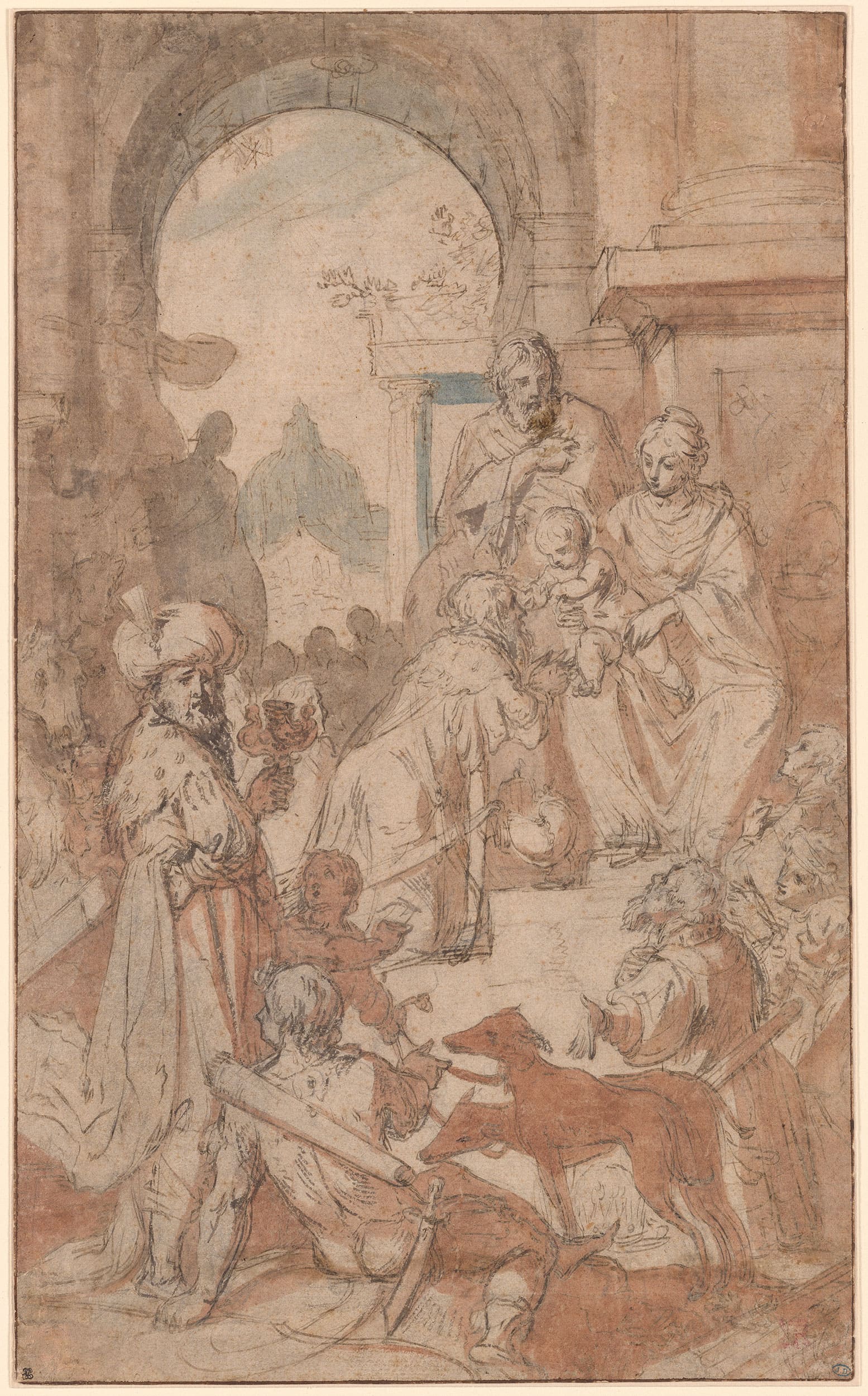
Paola Pacht Bassani (Claude Vignon 1593-1670 exh. cat. Tours, 1993-94, p. 523-24) rejected this sheet as by Vignon and suggested it may be by another French master active around 1620-30. Vignon was one of many artists who produced painted versions of the Adoration of the Magi in the 1620s-50s. Works by French, Flemish and Italian artists feature variations on this popular composition utilizing many of the same elements. What distinguishes this design is its exaggerated vertical format, its architectural (rather than rural) setting (lacking any suggestions of a lean-to or ruins housing the Holy Family), that only two of the three kings are noticeably depicted (and that the artist eschewed representing a Black king), and the inclusion of an elegantly posed roman soldier in the foreground who reclines alongside two dogs on a leash held by a boy accompanying the king. This arrangement of the figures in an open oval configuration and the strong diagonal of the composition are not common features of the many Adoration scenes from this period. The architecture, and view of a domed church in the distance, points more to an Italian author, or to a French artist working in Italy. The use of red chalk wash and blue watercolor is another distinctive feature and one that sets it apart from Vignon's oeuvre.
Discussion Active
Discussion Closed
Martin Hirschboeck January 16, 202610:24 am
Technique and style of the drawing remind me of works by Frans Francken the Younger. Could be worth checking.
The tecnique recalls Cigoli and Coccapani’s works, but not the style. Anyway, I’d like to highlight the presence of the St. Peter’s Keys on the right, next to Madonna with Child. The painter was in Rome, probably working on a papal commission during the first half of the XVII century (and maybe on the background that’s the Vatican Basilica).
I would suggest Hans Rottenhammer, or possibly Hendrick van Balen, as the two are closely related and often confused with one another. The latter was particularly inclined to include figures wearing turbans, and the depiction of the Virgin is quite distinctive of his style.
Austeja, it’s true the blue wash , red chalk and coloring are similar to the look of some “Sweelinck” drawings. Only want to throw into the pot the idea that it it’s French Jacques Stella was in Rome at the time and was using blue wash. Once home I’ll look thru some books.
Is it actually Dutch? The compositional arrangement, the use of reddish and blue washes, some of the facial types (esp. the boy looking up, next to the king who is looking at us), and the treatmeant of the background makes me think of Gerrit Pietersz.
Possibly D. Kaieman (1796-1857), Brussels; his sale, Paris, 26 April-1 May 1858; Jules-Alexandre Duval le Camus (1814-1878), Paris (Lugt 1441); Marquis Philippe de Chennevières (1820-1899), Paris and Bellesme (Lugt 2072); his sale, P. Roblin, Paris, 7 April 1900, lot. 507; Jacques Petit-Horry (1929-1992), Paris.
Artwork Literature
Ryskamp, Charles, ed. Twenty-First Report to the Fellows of the Pierpont Morgan Library, 1984-1986. New York : Pierpont Morgan Library, 1989, p. 387.
Artwork Further Information
Watermark: none visible through lining.
Claude Vignon, to whom this sheet was attributed, was one of many artists who produced painted versions of the Adoration of the Magi in the 1620s-50s. Works by French, Flemish and Italian artists feature variations on this popular composition utilizing many of the same elements. What distinguishes this design is its exaggerated vertical format, its architectural (rather than rural) setting (lacking any suggestions of a lean-to or ruins housing the Holy Family), that only two of the three kings are noticeably depicted (and that the artist eschewed representing a Black king), and the inclusion of an elegantly posed roman soldier in the foreground who reclines alongside two dogs on a leash held by a boy accompanying the king. This arrangement of the figures in an open oval configuration and the strong diagonal of the composition are not common features of the many Adoration scenes from this period. The architecture, and view of a domed church in the distance, points more to an Italian author, or to a French artist working in Italy. The use of red chalk wash and blue watercolor is another distinctive feature and one that sets it apart from Vignon's oeuvre.
Paola Pacht Bassani (Claude Vignon 1593-1670 exh. cat. Tours, 1993-94, p. 523-24) rejected the sheet as by Vignon and suggested it may be by another French master active around 1620-30.



Martin Hirschboeck January 16, 2026 10:24 am
Technique and style of the drawing remind me of works by Frans Francken the Younger. Could be worth checking.
Disegni_et_Inventioni November 6, 2025 12:45 pm
The tecnique recalls Cigoli and Coccapani’s works, but not the style. Anyway, I’d like to highlight the presence of the St. Peter’s Keys on the right, next to Madonna with Child. The painter was in Rome, probably working on a papal commission during the first half of the XVII century (and maybe on the background that’s the Vatican Basilica).
jahelssp@hotmail.com July 21, 2025 3:21 pm
I would suggest Hans Rottenhammer, or possibly Hendrick van Balen, as the two are closely related and often confused with one another. The latter was particularly inclined to include figures wearing turbans, and the depiction of the Virgin is quite distinctive of his style.
Monroe Warshaw July 3, 2025 10:32 am
Austeja, it’s true the blue wash , red chalk and coloring are similar to the look of some “Sweelinck” drawings. Only want to throw into the pot the idea that it it’s French Jacques Stella was in Rome at the time and was using blue wash. Once home I’ll look thru some books.
Austeja Mackelaite July 2, 2025 3:56 pm
Is it actually Dutch? The compositional arrangement, the use of reddish and blue washes, some of the facial types (esp. the boy looking up, next to the king who is looking at us), and the treatmeant of the background makes me think of Gerrit Pietersz.